Does X Shadowban You? How to Check and Actually Fix It in 2026
Wondering if X is shadowbanning your posts? Here's the exact 2026 test, what the open-source algorithm reveals, and the fastest way to fix it.

You post something, it gets nothing. Not a bad take, not controversial, just... silence. Zero impressions, no replies, maybe a couple of likes from people who already follow you. Naturally you start typing "am I shadowbanned on X" into Google at 11pm, hoping someone can tell you what's going on.
Here's the problem with most of what you'll find when you search that: it's either a checker tool trying to sell you a subscription, or a guide that lists four generic "signs" you're shadowbanned without ever explaining what's actually happening inside X's ranking system. Almost none of them mention that the actual weight values X uses to penalise your account are deliberately hidden from the public code, or that X quietly updated its visibility-filtering policy in 2025 to cover new categories of content.
This piece covers what a shadowban on X actually is in 2026, how to test for it properly (including the official method X now provides), what the open-source algorithm reveals about how suppression works, and the exact steps to get your reach back. No vague reassurances, no "just wait and see."
What "Shadowban" Actually Means on X
First, the honest bit nobody likes to say clearly: X doesn't use the word "shadowban." A "shadowban" is not a single, official feature or label on Twitter or X. On X, the word "shadowban" is an informal term people use to describe a range of visibility and reach limitations that reduce how widely content is distributed, often without any direct warning or notification to the account owner.
What people call a shadowban is really a bundle of separate mechanisms. What users call shadowban is actually one of several quieter actions the platform takes: search suggestion exclusion (your account doesn't autocomplete when typed), reply deboosting (your replies only show to direct followers, not to the conversation's wider audience), For You exclusion (your posts stop appearing in algorithmic feeds), trend blocking (your tweets don't count toward trending topics), and account labels (visible warnings like "Account temporarily restricted") which are explicit, not shadow.
That last category matters a lot, because it means some of what people call a "shadowban" isn't hidden at all. It's just something you haven't checked for yet.
The Real Types of X Shadowban in 2026
Not every reach problem looks the same, and lumping them together is why most fixes fail. Based on how X's own systems and third-party detection tools categorise it, there are four distinct patterns:
Search ban. Your post does not appear in search results, even when users search for exact words from your tweet.
Hashtag/discovery ban. Your post does not show under the hashtags you used, even if the post is still visible on your profile.
Reply deboosting (also called QFD, or "quality filtering discussions"). This is arguably the most common one in 2026. In practice, the most-reported difference users notice in 2026 vs the pre-2022 era is that reply deboosting (QFD) is now far more aggressive. Replies that would have been visible in 2021 frequently end up in the "show additional replies" hidden module today, especially for non-Premium accounts.
Ghost ban / For You exclusion. Your account works fine, but your content stops surfacing to anyone outside your existing followers. This is the one most people mean when they say "shadowban" without realising there's a name for it.
Since 2018, third-party detection has mostly relied on the same core checks. The detection methodology hasn't changed though, the same four signals shadowban checkers test have been the canonical shadowban indicators since shadowban.eu first published them in 2018. What has changed is what triggers them, and that's the part worth understanding properly before you go looking for a fix.
How to Check If You're Shadowbanned on X
Don't rely on a single test. Run all of these before you conclude anything, because a drop in reach can come from several unrelated causes, not just suppression.
Start With X's Own Account Status Screen
This is the step almost every other guide on this topic skips, and it's the most reliable one available because it comes straight from X rather than a scraper-based third-party tool. Go to Settings → Account → Account Status. If X has applied an explicit label (spam, sensitive content, etc.), it's visible there with a reason and an appeal link.
If there's nothing listed there, you're not dealing with an official restriction. That doesn't rule out algorithmic deboosting, but it does rule out the worst-case scenario.
Run the Logged-Out Search Test
Log out and search from:yourusername in the Latest tab: missing recent posts mean a search ban. Then check Settings, Your account, Account status for any official reach label. Do this from a browser where you're not signed in, or ask a friend who doesn't follow you to run it. If your own recent posts don't show up when searching your exact handle in the Latest tab, that's a strong signal of a search ban rather than just low organic reach.
Check Whether You Autocomplete
Type the first few letters of your username into search while logged out. Open a private/incognito browser window where you're not logged into Twitter, go to Twitter search and type your exact username. If you don't appear in suggestions, you may have a search ban.
Test Your Reply Visibility
Reply to a large account's post, then ask someone who doesn't follow you to open that thread and look for your reply without clicking "show more replies." Have someone who doesn't follow you check if your replies are visible in conversations. If your replies are consistently buried under a "show more" fold even when they're relevant and not remotely spammy, that points to reply deboosting.
Look at the Data, Not Just the Vibe
Numbers beat feelings here. Near-zero impressions on recent tweets while older tweets still show engagement confirms active suppression, and profile visits dropping alongside impression drops reinforces the pattern. Pull your last 20 posts and compare impressions week over week. A steady, gradual decline usually points to content or timing issues. A sudden cliff edge, especially right after a specific action (mass following, a flagged reply, an automation tool), points to an actual restriction.
Run this alongside proper analytics rather than guesswork. If you haven't set up a real tracking habit yet, our guide on using X analytics to grow faster walks through exactly which numbers to watch weekly, and Xpert's free Engagement Checker will give you a live engagement rate and per-post average for any public account in seconds, so you've got a baseline before you start troubleshooting.
Here's a demonstration of the manual check process if you want to see it done step by step:
The Honest Caveat on Third-Party Checkers
Plenty of tools promise instant shadowban detection. Treat the results as directional, not gospel. These tools check your account against known shadowban indicators and report which types of restrictions (if any) are active. They're not official X tools, so treat results as strong indicators rather than guarantees. Cross-reference whatever a checker tells you against the manual tests above and X's own Account Status screen before you act on it.
What the X Algorithm Actually Says About Suppression
This is the section most competing articles skip entirely, and it's the difference between guessing and understanding. In January 2026, xAI published the complete rewrite of X's recommendation system on GitHub, and it's been updated on a public cadence since. In March 2023, Twitter open-sourced a partial version of its recommendation system. In January 2026, xAI went further, releasing the complete Grok-powered replacement at github.com/xai-org/x-algorithm and committing to public updates every four weeks.
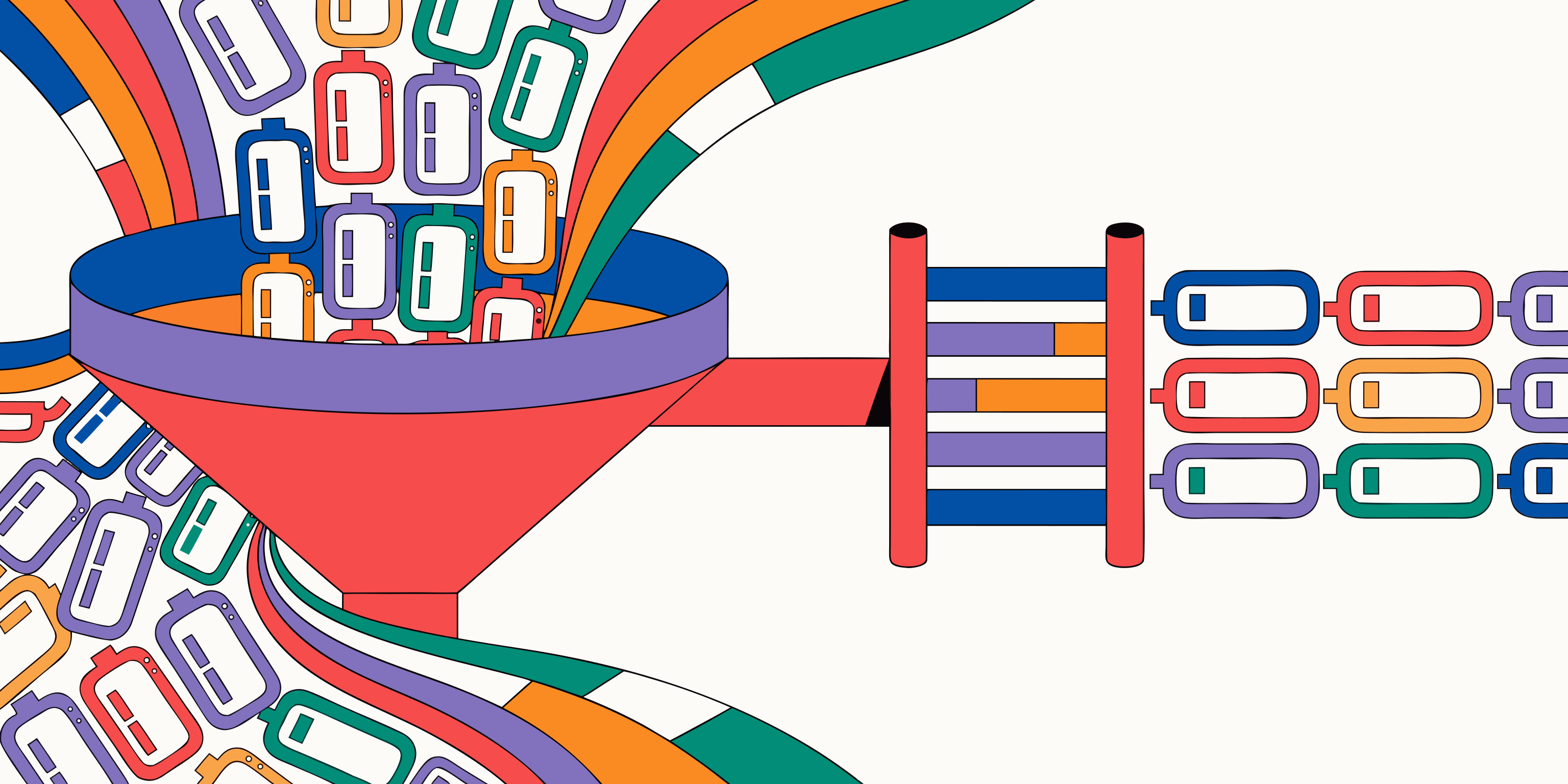
The system works by narrowing an enormous pool of candidates down to a tiny shortlist, then scoring them. The For You feed algorithm retrieves, ranks, and filters posts from two sources: In-Network (Thunder), posts from accounts you follow, and Out-of-Network (Phoenix Retrieval), posts discovered from a global corpus. Both sources are combined and ranked together using Phoenix, a Grok-based transformer model that predicts engagement probabilities for each post, and the final score is a weighted combination of these predicted engagements. The algorithm narrows 500 million daily tweets down to roughly 1,500 candidates per user, then ranks those candidates.
Crucially, there's a distinct filtering step after ranking that removes content entirely. Visibility Filtering is post-selection enforcement that removes content based on safety/policy categories (spam, deleted, violence, etc.). That's the closest thing to an official definition of what people call a "shadowban," and it's a separate mechanism from the ranking penalties applied by predicted negative engagement.
The Part Nobody Tells You: The Real Weights Are Hidden
Here's the honest detail that most "algorithm explained" posts either don't know or gloss over. The formula for scoring your posts is public. The numbers inside it are not. The combined score adds up predicted probabilities for positive actions, then subtracts four negative ones: predicted probabilities for "not interested," block, mute, and report, each multiplied by their own weight constant. Every single one of those weight constants lives in a module called params that was explicitly excluded from the open-source release, and the comment in lib.rs is direct, excluded for security reasons.
That means every specific multiplier you've seen quoted online (block at -3.0, reply at 13.5x a like, and so on) is an estimate, not confirmed code. Different analyses land on very different numbers. One breakdown estimates a single block is worth -3.0, while a like is only +0.5, while another puts it at a -1000x penalty as the strongest negative signal, where multiple blocks from different users can crater your reach, and a third estimates negative actions like blocks, mutes, and "not interested" clicks at approximately negative 74 times weight. Directionally these all agree: negative signals matter far more than positive ones. The exact multiplier is genuinely unknowable from the public code, and any article that states one confidently as fact is guessing.
What is confirmed, and this is the bit that actually changes how you should behave, is that the system doesn't wait for someone to actually block you. The thing that surprised analysts most is that negative signals are predicted, not just tracked. The model doesn't wait for actual blocks, mutes, or reports. It predicts whether a user would block, mute, or report this content, and that prediction alone lowers your score, with zero actual blocks needed.
In other words: content that merely looks like the kind of thing that annoys people (aggressive tone, spammy formatting, engagement-bait phrasing) gets pre-emptively demoted, before anyone even reports it. That's a much bigger deal than any single confirmed weight, and it's exactly why "clean up your behaviour before appealing" works better than arguing you did nothing wrong.
The Visibility-Filtering Policy Update You Probably Missed
Separate from the ranking model, X's actual visibility-filtering policy expanded in 2025. The current X visibility-filtering policy, last updated in 2025, explicitly applies reach throttling to accounts flagged by community notes for misinformation (even on a single tweet), accounts with low "Trust & Safety scores" in X's internal grading, tweets containing certain keywords that X moderators classify as inflammatory, and replies that pattern-match to coordinated brigading or pile-on behaviour.
If you've had a single post hit with a Community Note recently, that's worth checking as a cause even if you weren't consciously breaking any rules.
What Actually Triggers a Shadowban in 2026
Most causes fall into a small number of behavioural patterns, and X's detection is pattern-based rather than one-strike. Most shadowbans are pattern based, meaning if you go back to the same setup and the same behaviour, you'll get hit again, sometimes faster.
Automation and bulk actions. Bots, auto-replies, mass-follow tools, and aggressive third-party automation can increase risk. Anything that mimics a script rather than a human, rapid-fire follows, identical reply text sent repeatedly, liking dozens of posts in seconds, gets flagged fast.
Cross-posting the same content everywhere. Posting similar content across several accounts or using multiple accounts to engage with the same content is one of the more overlooked triggers, especially for people running a business account alongside a personal one.
Sudden spikes in activity. If your account typically posts twice a day and suddenly posts fifteen times in an hour, that's a pattern break the system notices regardless of content quality.
Links dropped without context. X's ranking still deprioritises off-platform traffic. External links are algorithmically suppressed, since X wants to keep users on-platform, and posts containing links receive near-zero distribution from non-Premium accounts, even Premium users see links underperform compared to text and native video. The common workaround is posting the main content without a link, then dropping the URL in a reply. This isn't technically a shadowban, but it looks and feels exactly like one if you don't know it's happening.
Rapid follow/unfollow cycling. Growth hacks built on aggressive follow-unfollow loops remain one of the fastest routes to a genuine restriction, not just reduced reach.
Compromised account activity. Check whether any unknown apps have access to your account, remove suspicious third-party apps, change your password, and enable two-factor authentication, because if your account was compromised, strange activity could trigger restrictions. This one's easy to skip because it feels unlikely, but it's a five-minute check that rules out a real problem.
How to Fix a Shadowban on X
Work through this in order rather than jumping straight to "wait it out."
Step one: confirm what type you're dealing with. Use the Account Status check and the manual tests above before changing anything. Fixing the wrong problem wastes time and tells you nothing.
Step two: stop the triggering behaviour immediately. If you've been running automation, mass-following, or posting in bursts, stop completely rather than tapering off. If you suspect a shadow ban: stop any automated behaviour, remove potentially violating content, take a break for 2-3 days, and engage naturally with quality content.
Step three: audit your connected apps. Revoke access for anything you don't recognise or actively use, particularly growth tools that ask for broad permissions to your account. Remove anything you don't use, especially "growth" tools that ask for broad permissions, even if they claim they're safe.
Step four: go quiet for a short, deliberate window. This isn't about disappearing for a month. Test with the free tools above, identify what triggered it, stop that behaviour, and wait 48-72 hours. Most automated restrictions are designed to lift on their own once the pattern stops repeating.
Step five: check your profile completeness. An algorithm that's trying to distinguish real people from bots and spam networks weighs a complete profile heavily. It's important that your profile looks genuine and complete, as the X algorithm first checks whether an account belongs to a real person or a bot, and if your profile looks incomplete, fake, manipulated or confusing, the algorithm won't quickly lift restrictions on such accounts.
Step six: appeal if there's an explicit label. If Account Status shows a specific reason, use the appeal link attached to it rather than generic support channels. If you believe the restriction is unjust, you can reach out to X Support to appeal it, explain your situation clearly and provide relevant context, and keep in mind that getting a response might take some time. For anything without an explicit label, there genuinely isn't a formal appeal path. There's no official appeal process specifically for shadowbans, though you can contact X support if you believe it was applied incorrectly, and mostly the best approach is to wait it out.
How Long Does a Shadowban Last?
This varies a lot depending on severity, and the honest answer is that most people overestimate how long it takes. Automated bans typically lift 24-72 hours after you stop triggering them, human-reviewed restrictions take 1-2 weeks, and repeat offenders can face restrictions that stay in place until a successful appeal. A separate estimate puts the general range even wider: shadowbans typically last anywhere from 24 hours to 2 weeks, depending on severity, though some users report longer durations.
If you're still seeing suppressed reach after five days of clean behaviour with no automation and no bursts of activity, it's worth filing that appeal rather than assuming it'll sort itself out.
Is It a Shadowban or Just Normal Algorithm Decay?
This is the question people skip, and it matters because plenty of "shadowban" complaints are actually just how the feed normally works. A shadowban is an active restriction by X's systems. Low reach can happen naturally due to algorithm factors like time decay, low engagement on recent posts, or link suppression. Check with a shadowban testing tool to distinguish between the two.
Time decay alone explains a huge chunk of "why did my reach die" questions. Time decay is steep: a post loses roughly half its potential visibility score every six hours. If your post simply didn't get engagement in the first hour, that's not suppression, that's the feed doing exactly what it's designed to do. Our full breakdown of how the X algorithm works in 2026 covers the early-engagement window in more depth if you want to rule this out properly, and if replies specifically are the thing dying, our piece on getting more replies on X is worth reading before you assume it's a restriction rather than a content problem.
Author diversity limits also mimic suppression symptoms without being one. X applies an 'author diversity penalty' that limits how many posts from a single account appear in any user's feed per session, so if you post 10 times a day, the algorithm won't show all 10 to your followers, it will pick the 2-3 strongest performers. If you're posting a lot and your weaker posts are quietly getting nothing, that's not a shadowban either.
How to Avoid Getting Shadowbanned Again
Prevention here is genuinely simple, even if consistency is hard.
Space your activity out across the day instead of dumping it in bursts. Spread your posts throughout the day, since posting too many tweets at once is one of the fastest ways to trigger X's spam filters. A scheduler helps here far more than trying to remember to post manually at odd hours, and it's the exact reason tools like Xpert's content calendar exist. If timing has always been a guessing game for you, check our best times to post on X in 2026 guide, or run your own audience's active windows through the free Best Time to Post tool.
Vary your replies. Don't copy-paste the same replies; each response should be unique. Copy-paste engagement is one of the clearest automation fingerprints X's classifiers look for.
Keep follow and unfollow activity well within sensible limits. Stay within daily follow/unfollow limits and don't push the boundaries.
Never hand your account credentials to unofficial automation. Never use tools that auto-post or auto-engage; always post manually, or use tools that work through X's official API rather than scraping or credential-sharing. That distinction matters more than people realise: a legitimate scheduler that authenticates through your X login and posts through official channels carries a fundamentally different risk profile than a browser extension that logs in as you and clicks buttons on your behalf.
Keep your profile looking like it belongs to an actual person or brand. Use a username and display name that represents a real person or brand, avoid random characters or suspicious names, and use a clear photo or brand logo with a proper banner instead of a blank or default profile picture.
If you want a running check on whether your account's fundamentals look healthy without guesswork, run it through Xpert's free Shadowban Check tool periodically, particularly after any period where you've tested a new growth tactic.
FAQ
How do I know for sure if I'm shadowbanned on X?
Run more than one test rather than trusting a single signal. Run more than one test, because no single signal is conclusive: start with X's native Account status to catch any explicit label, then confirm a search ban with a logged-out from: search, check autocomplete for a suggestion ban, and use a second method like asking a non-follower to check your reply visibility. If two or more of these point the same way, you've got a real answer, not a guess.
Does X tell you if you've been shadowbanned?
Only sometimes, and only for the explicit version. X rarely tells you anything directly, there's no clear warning, no email, no big red banner saying "we limited your reach", it just kind of happens, or at least it feels that way. The one exception is the Account Status screen, which does show a reason and an appeal link for formal labels, but algorithmic reach reduction typically comes with no notification at all.
Can using a growth or scheduling tool get me shadowbanned?
It depends entirely on how the tool works. Tools that log in as you and simulate clicks (mass following, auto-liking, identical automated replies) carry real risk, because bots, auto-replies, mass-follow tools, and aggressive third-party automation can increase risk. Tools that authenticate through X's official API and simply help you draft, schedule, and post at sensible intervals don't carry that same risk, because they're not mimicking bot behaviour, they're just replacing manual copy-paste with a queue.
Will deleting posts fix a shadowban?
Sometimes, if a specific post triggered a content-level restriction rather than an account-wide one. But deleting posts blindly without identifying the actual trigger rarely helps on its own. It's more useful to identify and stop the behaviour pattern first, then decide whether a specific post needs removing, rather than deleting everything and hoping.
How long before a shadowban lifts if I do everything right?
Most cases resolve faster than people expect. X applies these limits silently, and most automated ones lift within 24 to 72 hours. Human-reviewed or repeat-offence restrictions take longer, sometimes a week or two, and in rare cases require a successful appeal before anything changes.
Is reduced reach always a shadowban, or could it just be the algorithm?
Not always. A lot of what feels like suppression is just normal ranking behaviour, particularly steep time decay, where a post loses roughly half its potential visibility score every six hours if it doesn't get early engagement. Before assuming you're restricted, rule out timing, content quality, and the author diversity limit that caps how many of your posts show to the same follower in one session.